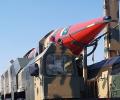
Pakistan will not delegate "advance authority" over nuclear weapons to military unit commanders even in the event of a crisis with India, according to a media report.

He, however, acknowledged that Russia and some other countries were behind the hacking of Democratic Party computers.

Sitharaman, who is in Russia on a three-day visit, also met her Chinese counterpart Wei Fenghe on the sidelines of the international security conference.

A summary of sports events and sports persons, who made news on Tuesday

'Mumbai is very different from the rest of India. It can be ruthless if you don't have work or friends. The struggle time and times of disappointment are horrific and can break you.'

'It is strange that a country like India, which had gone through crisis after crisis resulting from militancy, insurgency and terrorist attacks, should still be practising ad hocism in managing its security imperatives,' says B S Raghavan, the distinguished civil servant and former member of the Joint Intelligence Council.

'It is imperative to restore the dignity and authority of the services chiefs. Erosion of this has resulted in lowering of service efficiency. It is also time to end the practice of taking seniority as the sole criterion for appointing chiefs.'
'We think Pakistan has moved decisively against terrorists that threaten Pakistan internally, but still needs to devote attention to those that represent a threat to their neighbours.'

'A Russia-Iran-China-Pakistan geopolitical grouping is evolving at this point of time.' 'Given that the grouping is in its nascent stages, will this week's terrorist attack in Mirjaveh affect it?' asks Aveek Sen.

Tillerson said China's behaviour and action is "posing a challenge to the rules-based international order".

'Vietnam has become an adjective as well as a verb -- the Americans, for instance, were driven by the passion to do a 'Vietnam' on the Soviet Union when that country invaded Afghanistan in 1979.'

10 takeaways from the prime minister's UN speech.

In 1954, a bench of eight Supreme Court judges declared that the Constitution-makers did not recognise the Fundamental Right to Privacy. It is hoped that a larger bench as and when constituted will uphold the Right to Privacy as a Fundamental Right overruling the 1954 decision, says the distinguished lawyer, P P Rao.

Australia Prime Minister Tony Abbott said, "We owe it to the dead to bring the guilty to justice".

There are signs of China's external behaviour becoming more aggressive in the coming years. If that happens, strategic implications for neighbours having territorial disputes with China can become deeper and imperatives can rise for the former to counteract, says D S Rajan

'As far as I know Burhan Wani did not kill anyone.'

'The digital age has forced diplomats to be less formal and more accessible, reaching out to ordinary people both within and outside their countries, combining statecraft with streetcraft,' says former foreign secretary Ambassador Shyam Saran.

His view will be shaped by his perception of US world interests and India's economic performance relative to China.

Despite being in the crosshairs of the police, politicians and vigilantes, Malini Subramaniam continues to report from a hotbed of Maoist insurgency.

Summary of sports events and persons who made news on Friday
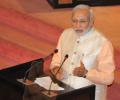
Modi strongly pitched for enhanced cooperation in key areas of maritime security and counter-terrorism.

Mohan Bhagwat said the temple would be constructed in the same grandeur as it existed before, using the "same stones" under the guidance of those who were the flag-bearers of the Ram Janmabhoomi movement for the last 25 years.
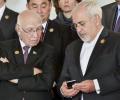
He did not mention the issue of Jammu and Kashmir.

Delhi Development Authority's land deal to Reliance Industries throws up larger issues of governance.

North Korea is unlikely to strike first, but its response in retaliation, if attacked, could be massive even at the expense of its own destruction, says Rajaram Panda.
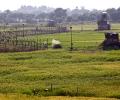
'The incidents have remained confined to the paramilitary forces on both sides with both the armies scrupulously avoiding getting involved. While this incident has been going on, the LOC has been reasonably quiet. Cross border firing achieves no tactical or strategic aims and is more a symptom of hostility. Unfortunately, India has to learn to live with this. Like Israel, we must construct shelters for the border populations and be ready to retaliate in kind,' says Colonel Anil A Athale (retd).
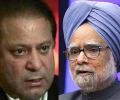
'The talks have to go on because we want to know what Nawaz Sharif has in his mind. We want to see how much he can deliver. We want to see if he can wrest back power from the army,' a senior government official, who deals with Pakistan, tells Sheela Bhatt.

With 2016 officially behind us, let's look forward and speculate about the events, people and issues that will shape 2017.
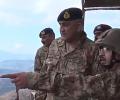
'The Pakistani military has encouraged and supported terrorist organisations, especially in Kashmir, as a means of waging proxy war against the Indian military and the country's superior economic resources.' 'The evidence is irrefutable with the recent killing of 46 paramilitary troops being just the latest example.'
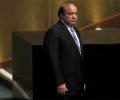
'Indian diplomacy is once again being saddled with the heavy burden of a Pakistan-centric foreign policy. It is something grossly unfair at a crucial juncture in India's trajectory as an emerging power on the global stage,' argues Ambassador M K Bhadrakumar.

A lesson for Jeetendra from Raaj Kumar, Shashi Kapoor delivering gas and Susan Sarandon-Jessica Lange's caustic retelling of the infamous Bette Davis-Joan Crawford feud, Sukanya Verma's super-filmi week turned out to quite a blast from the past.

'How can a State, which claims to be a responsible power, unilaterally grab a "disputed" area to build a road on it?' asks Claude Arpi.

>What happens when two teenagers -- one Israeli and one Palestinian -- discover that they were accidentally switched at birth? The Other Son is a wonderful vision of Israel and Palestine. There is no positive future for the region and its people without this vision, feels Aseem Chhabra.

Excerpts from Prime Minister Narendra Modi's speech at the Combined Commanders Conference on board the INS Vikramaditya at sea, off the coast of Kochi.

India-Israel relations are at a crossroads. Simply chanting old hackneyed mantras on terrorism, secularism, democracy, et al, won't suffice. There is danger of stagnation setting in, says Ambassador M K Bhadrakumar.

In the 2012 election, the BJP's performance was the poorest in Purvanchal, winning only 12 of the region's 112 seats. Will 2017 be different? Will the party ride on Varanasi MP Narendra Modi's charisma?

'In the short to medium term, the Myanmar raid will impose caution on Pakistan in planning another 26/11-like adventure. As a result of this caution, even if the proxy war ebbs, it will reduce the danger of escalation to a nuclear stand-off,' says Colonel Anil A Athale (retd).

In its plea, Karnataka had said its reservoirs are dry and it can only release water to Tamil Nadu by the end of the year.

Sri Lankan President Maithripala Sirisena will visit India on his maiden foreign trip next month even as he ordered the release of all Indian fishermen in custody in Colombo as a goodwill gesture on the first day in office.

In a historic decision, President Barack Obama announced a series of steps aimed at normalising relations with communist-ruled Cuba, with which the US had severed diplomatic ties decades ago imposing a series of sanctions on its island neighbour.
 © 2026 Rediff.com - Advertise with us - Disclaimer - Privacy Policy - Sitemap - Feedback - About us - Terms of use - Grievances